An inference primer for Go engineers
Chapter 4 — The loop and the KV cache
One forward pass gives one token. Getting a paragraph means running it hundreds of times, and doing that naively is quadratically wasteful. This chapter is about the memo table that fixes it, and the costs the fix creates.
Autoregression
The loop is embarrassingly simple:
tokens := tokenize(prompt)
for !done {
    scores := forward(tokens)
    next   := sample(scores)
    tokens = append(tokens, next)
}
Each generated token becomes input for the next round. That is autoregression, and autoregression is why generation is inherently sequential — you cannot start token N+1’s forward pass before token N exists, because token N is part of token N+1’s input.
That single fact shapes everything. Autoregression is why decode underuses hardware, why speculative decoding (Chapter 9) is interesting at all, and why generating 500 tokens takes roughly 500 times as long as generating one token.
The waste
Look at what the loop recomputes. On round 100, forward receives 100 tokens and runs the
entire stack over all of them. On round 101 it receives 101 tokens and runs the entire stack
over all of them — including the 100 it just did, producing identical results.
Attention is the stage where the recomputation bites. Chapter 2’s description: for each position, compare that position’s query against the keys of every earlier position and mix the corresponding values. The key and value vectors for position 5 depend only on the token at position 5 and on what came before position 5. The key and value vectors for position 5 do not change when you append token 101.
So the key and value vectors are being recomputed hundreds of times for nothing.
The cache
Keep the key and value vectors. Keeping them is the KV cache, and the KV cache is the single most important optimization in inference.
After computing the key and value vectors for a position, store the key and value vectors. On the next round, compute key and value vectors only for the one new token, append the new vectors to the store, and run attention against the whole stored set:
  WITHOUT the cache, round N          WITH the cache, round N

  recompute K,V for all N positions   compute K,V for 1 new position
  → work per round grows with N       → work per round is constant
  → total work over N rounds ~ N²     → total work over N rounds ~ N

  the comparison against N stored keys still happens either way —
  that term is what Chapter 8 is about
Per-token cost stops growing with the number of tokens generated so far and starts growing only with the comparison against those tokens.
The Go reading is a memo table on a pure function, which is exactly what it is: keys and values are a deterministic function of the prefix, and the prefix only ever grows at the end. Append-only memoization on a function whose inputs are a prefix of a slice.
This turns generation from quadratic into something much closer to linear, and there is no serious inference implementation without it.
What the cache costs
You have traded compute for memory, and the memory is not small.
The KV cache holds, for every layer and every position, a key vector and a value vector. The KV cache grows with every token generated, forever, for the life of the request:
  cache bytes = layers × positions × 2 × kv-width × bytes-per-number
                                     ^
                                     one key vector + one value vector

  qwen2.5-coder-1.5B, f32 cache: 28 layers, kv-width 256

    per position   28 × 2 × 256 × 4 B  =  57,344 B  =  56 KiB
    at 32,000 positions                =  1.84 GB

  the same model's weights on disk at q4_k_m are 1.12 GB — so at 32k
  context the cache is LARGER than the model it serves
Three consequences follow, and each is a real engineering thread in this repo.
Long context is a memory problem before long context is a compute problem. As the arithmetic above shows, at 32,000 tokens the KV cache can exceed the model’s weights in size. On a machine that barely fits the weights, the KV cache is what actually runs you out of memory.
The KV cache can be quantized too. Store keys and values in 8 bits instead of 16 and the
KV cache halves. Quantizing the KV cache is an accuracy trade like any other, and — as
docs/ollama-chase.md notes — KV quantization is not compatible with this repo’s bit-identical
determinism contract in the way some other optimizations are. Chapter 11 explains why that
determinism contract is worth protecting.
The KV cache can be reused across calls. If two requests share a prefix — the same system
prompt, or the next turn of the same conversation — the cached keys and values for that prefix
are still valid. goinfer implements prefix reuse as prompt-prefix reuse, and goinfer also
persists warm caches to disk in a .giw-kv format so the caches survive a restart.
Prefix reuse is why agentic workloads care about the KV cache. An agent loop resends a growing conversation every turn. Without prefix reuse, every turn pays full prompt-processing cost from scratch — and Chapter 8 shows that prompt-processing cost is large.
Where the cache doesn’t work
Some newer architectures make the cache impossible, and the reason is instructive.
Standard attention keeps a list: one key/value entry per position. Truncating the list to an earlier point is dropping entries off the end of the list. Reusing a prefix is keeping the first N entries of the list.
Gated DeltaNet layers — used in several recent Qwen models — keep a running total instead.
Each token folds into a single fixed-size matrix that is updated in place. deltaState in
decoder/deltanet.go is that running total, and deltaState’s comment says plainly that the
running total is fixed size, independent of sequence length, and not position-truncatable.
  STANDARD ATTENTION — a list          GATED DELTANET — a running total

  [k₁v₁][k₂v₂][k₃v₃][k₄v₄]             S = fold(fold(fold(fold(S₀,t₁),t₂),t₃),t₄)
     ↑ keep the first 2 to                    ↑ one fixed-size matrix, updated in place
       reuse a 2-token prefix
                                       to get back to "after t₂" you would have to
  truncate = drop entries              UNDO t₃ and t₄ — and the gate discarded what
  reuse    = keep a prefix             you would need to undo them. Not recoverable.
Fixed size sounds like a win, and for memory the running total is a win: the running total does not grow with context at all. But you cannot truncate a running total to an earlier position, and you cannot invert the update because the gating deliberately discards information. So for Gated DeltaNet layers:
- prefix reuse falls back to full recomputation
- speculative rollback (Chapter 9) is not possible at all
The loss of speculative rollback blocks an entire optimization family for those models. Chapter 9 picks that up.
More than one caller
Everything so far describes one conversation. A server has several, and the cache is what makes that awkward: it is per-conversation state, sized to a context window, and it belongs to the sequence that built it. Two callers cannot share one.
The Go instinct is to hand each request a goroutine and let the scheduler sort it out. goinfer does that for most of a request and then stops, deliberately. The path splits in two:
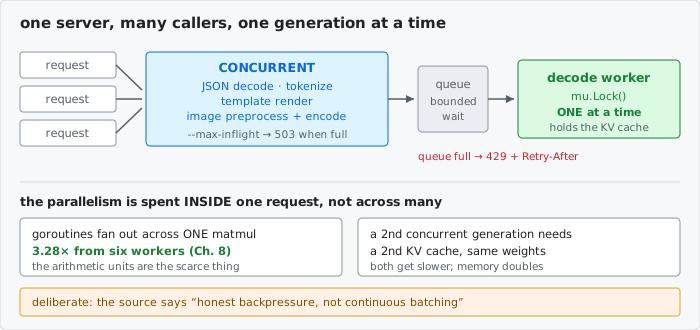
Before decode, requests really are concurrent, and that stage is capped globally so a burst of
large bodies cannot exhaust memory before anything has been generated. Generation itself is
serialized by a mutex whose comment says what it is — the single decode worker. Waiting
requests hold a slot in a bounded queue; when the queue is full the server returns 429 with a
Retry-After rather than accepting work it cannot start.
goinfer does not do continuous batching — the interleaving of many sequences into one forward pass that a throughput-oriented server is built around. The source says so in as many words: honest backpressure, not continuous batching. That is a stated position, not an omission, and it is worth understanding why a Go engineer might choose it.
The scarce resource is not goroutines. Goroutines are nearly free, but a second concurrent generation needs a second KV cache, and it competes for the same weights and the same arithmetic units. Running two at once on one machine does not make either faster; it makes both slower and doubles the cache memory. So the parallelism gets spent inside one request instead — Chapter 8’s 3.28× from six workers is goroutines fanning out across one matrix multiply, not across six users.
A queue that accepts everything lies. The alternative to a 429 is unbounded admission, where every client is accepted and every client gets slower, and no client can tell whether the server is busy or broken. Bounded queue plus an explicit refusal is the answer a caller can act on.
What survives across requests is not the loop but the cache’s contents: a prefix-keyed LRU lets a follow-up turn that shares a prompt prefix skip the prefill it already paid for. That is the same reuse this chapter has been about, moved up a layer.
The cost is throughput at scale, and it is real. One generation at a time means concurrent users queue rather than share a batch, and a server built to saturate a GPU with many streams will beat this by a wide margin. Chapter 10 states the same trade from the kernel side: if you are serving a model to many users at once, this is the wrong engine.
What it costs
The KV cache’s value is hard to state as a single number, because without the KV cache the workload is a different shape entirely. The useful framing is what the KV cache’s absence does: on the models above where prefix reuse cannot apply, each turn of a multi-turn conversation reprocesses the whole prompt from scratch.
At the shipped 6-worker default on CPU, a 3,020-token prompt takes 101.6 seconds to process. An agent loop that pays that every turn, twenty turns deep, spends over half an hour on prompt processing alone. With prefix reuse it pays it once.
Chapter 5 turns to the other memory problem: the weights themselves.
Sources: internal/serveapp/openai.go (the decode mutex, the bounded queue, the 429), internal/serveapp/main.go (--max-queue, --max-inflight), decoder/deltanet.go:145-153, docs/qwen3_5_moe.md, docs/ollama-chase.md,
docs/api-tiers.md (.giw-kv), docs/queue-performance.md (prefill baselines).